Amateur Radio Satellites
First contact with the world of hams
On this page I want to share more about this hobby and it's wonders. Now, I do not have a ham license and I am not transmitting anything, but in my opinion receiving is the most fun part.
I first discovered about this branch of ham radio when I bought a TID Radio TD-H8 handheld radio to try to receive airplane frequencies. Little did I know the frequency range of this radio doesn't cover the ones planes use. At first I felt a little down, but I decided to search for fun things to do with it anyway.
ISS Repeater & SSTV
One of the results in that search was the ISS FM Repeater. That's right! The International Space Station itself has an entire Amateur Radio system installed on it, and one of the radios works as a repeater. It has an uplink (the TX frequency, the one people use to transmit to it) of 145.99 MHz with a PL of 67 Hz and a downlink at 437.80 MHz. The PL is a tone that your radio must be configured to transmit along with your audio for the repeater to recognize your signal as valid. It is used to protect against unwanted noise / transmissions on the same frequency.
437.8 MHz is in the UHF band that my radio was designed to receive so i thought it would be fun to try to hear it. So, I looked online using apps like ISS Detector, Look4Sat or n2yo to find when the station would pass next over me. In ISS Detector I had to enable a settings to show passes in daylight, as those are hidden by default. No use for most people to look for a station they can't see during the day. Luckly, radio waves, at least at these frequnecy, don't really care if it's day or night.
Armed with my handheld, it's default antenna and determination, I went in my backyard to listen for the station's repeater. I barely heard anything during that attempt... Little did I know about the doppler shift, antenna orientation, circular polarization of the originally linearly polarized waves induced by their passing through Ionosphere and all the other knowledge required for a good reception of an object moving 7.6 km/s at +400 km above my head...
But this was the spark I need to start reseaching more about it. During that research I heard for the first time about SSTV (Slow Scan TV). It is a method hams use to enocde, transmit and decode an image using sound. I was fascinated by it. To make things even better, in less than a week, the ISS would organize an event in which they would send images from orbit using exactly this! It was the 28th eveniment, on 145.80 MHz, using PD120 mode. And to make this even more special, they would send certificates to anyone who would send at least a decoded image to the official gallery... Oh boy, the game was on!
Let's just say that the images I received during that event were not that clean, had quite a lot of static in them, but they were mine, download from orbit using only a handheld radio. I'll attach below two of them.
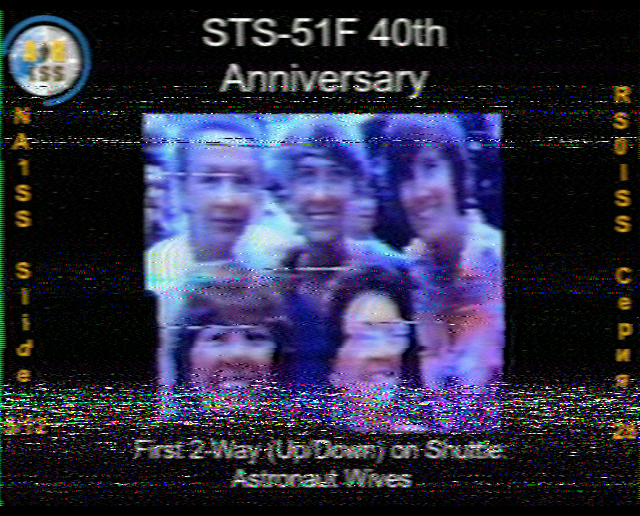
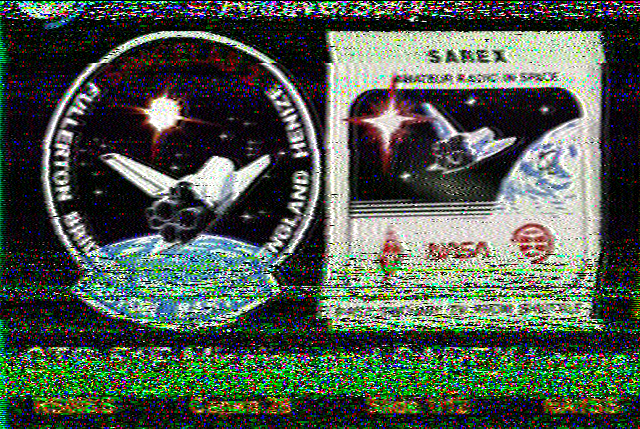
Having these images, I sent all of them to the official gallery and in less than a week, I've got my first certificate.
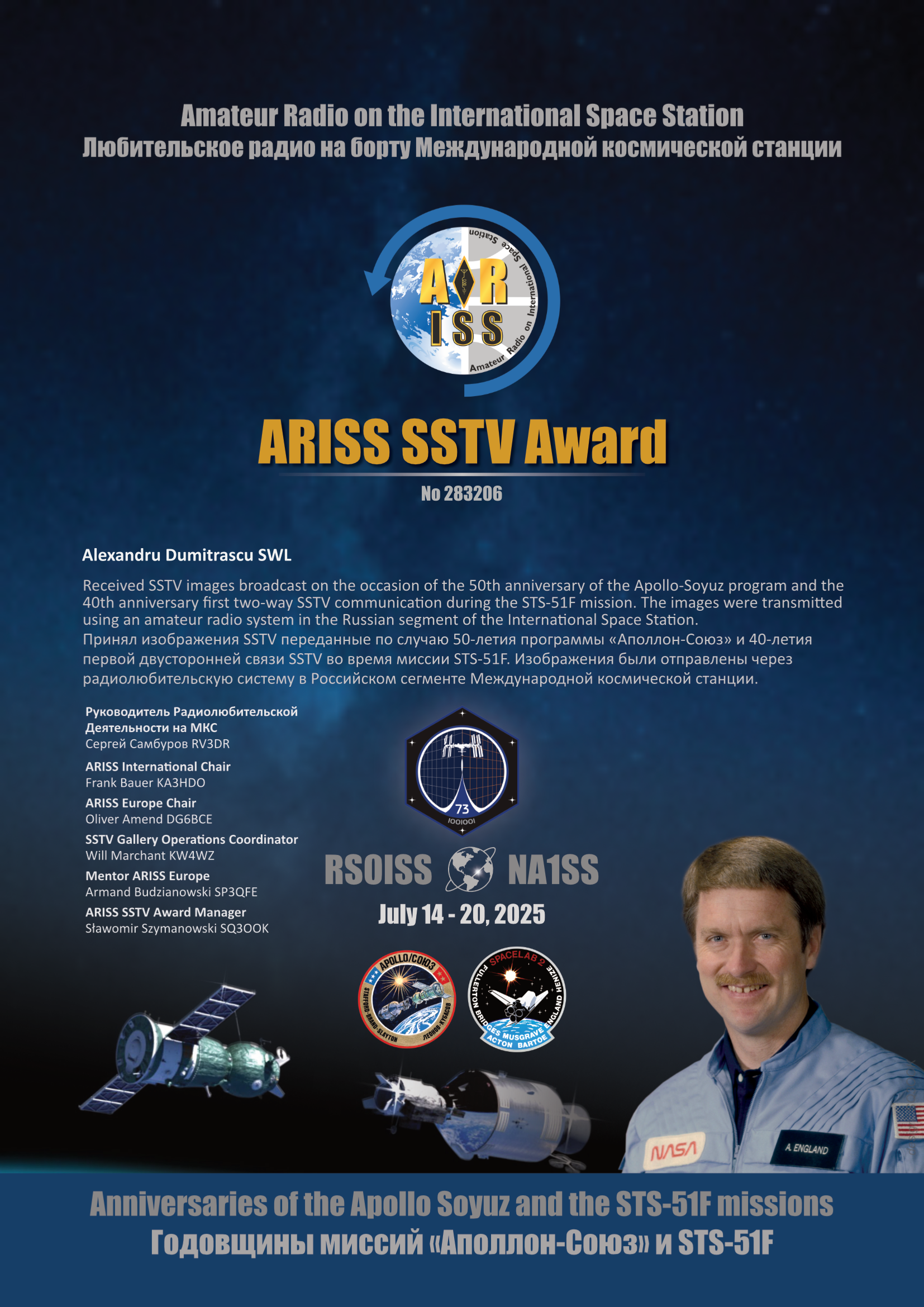
In terms of coolness in the nerd world of ham radio, I don't think anything can beat this! Needless to say, I took part in almost all the next SSTV events held by the space station and right now I am preparing for the 35th one!
Meteor M2-4 & Meteor M2-3
Before we talk about satellites like Meteor, I first have to introduce you in the world of Software Defined Radio (SDR). Personally, I stumbled upon it on Reddit communities after my first ISS SSTV event. I looked it up on AliExpress, RTL-SDR Blog V4 at a resonable price and, since I still couldn't listen to the airport and airplanes, I bought one. These things are supposed to let you listen to the entire electromagnetric spectrum from a few hundred kiloherz all the way to 1.7 GHz.
Now as my luck would be, I didn't know fakes of this thing existed and I managed to buy one of them... The signal was very noisy and reception was mediocre at best. I still managed to hear some airplanes, read their ADS-B data, plot them on a map, listen to local APRS broadcasts and hear some shortwave stations. So overall, I managed to do the things I wanted to do and put the SDR aside for a long while.
That was until I bought a Vector Network Analyzer, Nano-VNA, for a side project of mine. Using it, I could fine-tune DIY antennas for the exact frequency I wanted them to receive. Using it I made my 4-elements Yagi-Uda antenna, which I still use for the ISS events. It gives me VERY GOOD reception until the station is ~3 degrees in the sky and perfect images if I manage to aim it right.
When I researched for the Yagi antenna, I found posts made by people that received their own images from weather satellites, more specifically, Meteor M2-3 & 4. I knew that if I wanted to have a chance at receiving them, I would need an original SDR and not a clone. So, this time, I bought a real RTL-SDR Blog V3 from the official store on AliExpress, since the V4 is out of production.
When it arrived I tried to receive an image from Meteor M2-4 using the basic dipole it came with, having the legs length tuned with the VNA in an open field... It was a total fail! After that, I found out about the 120 degree V dipole and made a semi-permanent one using the antenna legs of the fake SDR and a PVC pipe. I went in front of my house to try Meteor M2-4 again... I thought it was a total fail, until I moved the frequency in SatDump (the decoding program) by 7 kHz to the left (idk why I need that, the Doppler shift can account for at most 3 kHz at 137.9 MHz, where these satellites transmit)...
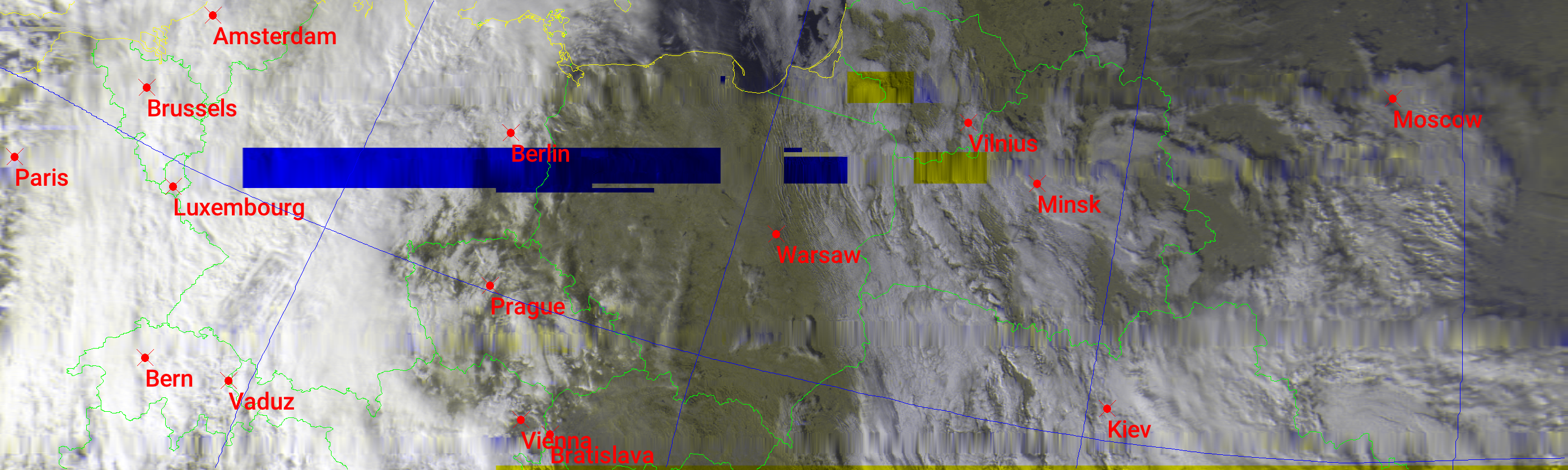
The moment I saw the image, I thought for myself: "THIS IS SO FUCKING COOL!!!". And I started to research for a better antenna. Gemini suggested me to try and build a Cross Turnstile with Reflector antenna, which after 3 days of research and 6 hours of hard work was done. The first try with it was also a failure... Apparently I left to much coaxial in the radiation lobe of the antenna and because the coaxial didn't have ferrite beads on it and since this is not a balanced antenna, it was acting as a stray element and radiator... I fixed those problems and tried again...
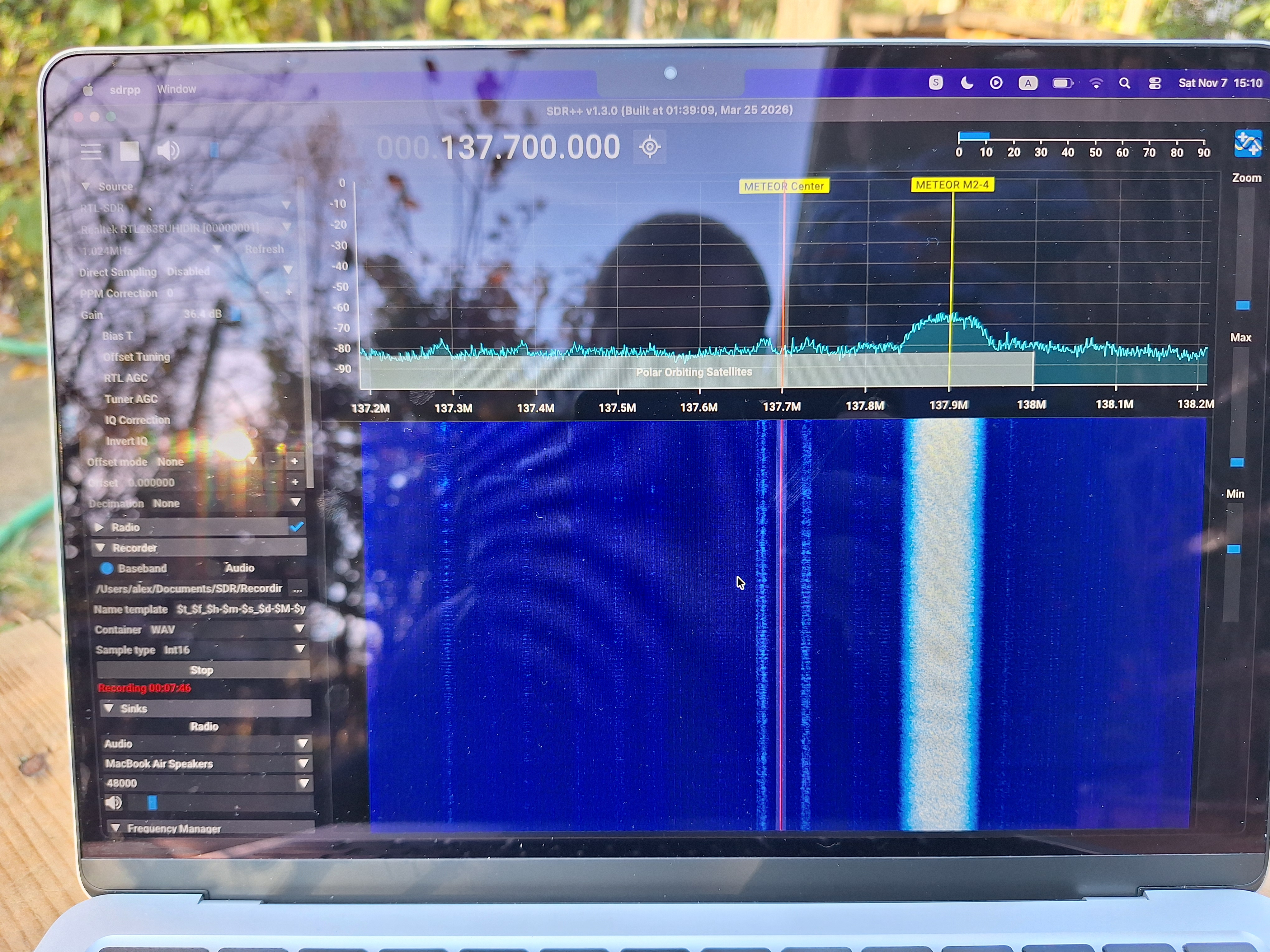
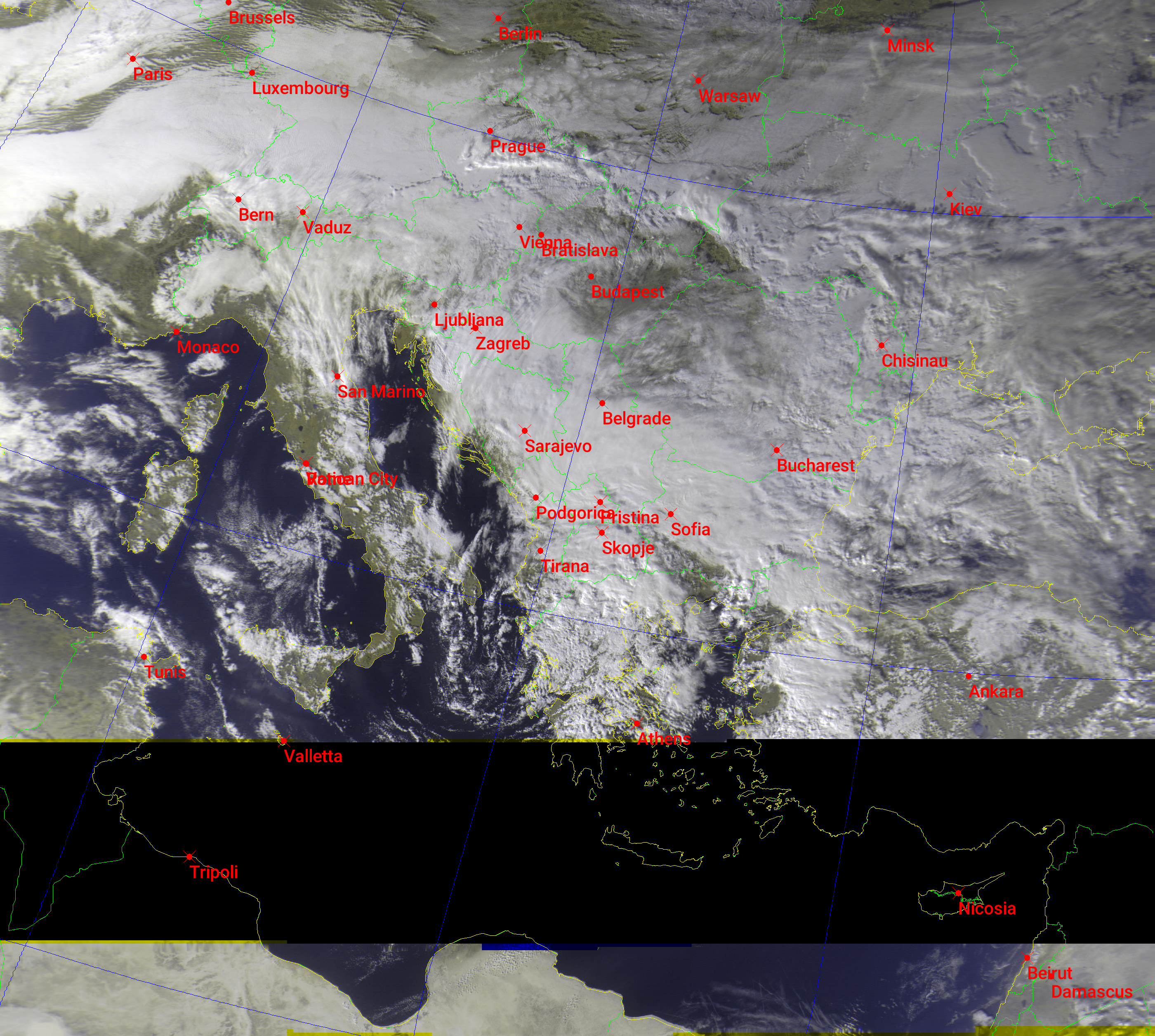
You can see in the images above the quallity of the signal and the image generated. The black bar was caused by the satellite going behind the house of a neighbour. It's amazing. Now, there is another antenna design I want to try, which should extend the radiation lobe to lower angles (I am not sure how useful this is, since I am surrounded by houses...), I need to somehow place the antenna at a height and I also think to start looking at the microwave part of the spectrum. But I don't have time for that right now!
So this will be the end of this really long post. I hope I sparked at least a little bit of interest, and who knows, maybe in the future when both of us may have a license, we'll meet on the air. 73!